


Note: self-distillation adds no knowledge to the model. Beam already solves most of these tasks when it is given several attempts; the fine-tuning refines that existing ability so that the first attempt succeeds more often.
How it works
- Each task is a PyTorch module that implements an operation (attention variants, normalisations, convolutions, losses, fused MLP blocks and so on), combined with input generators, the dtype and the numerical tolerances. The module is both the specification and the ground truth.
- Beam answers with a single Python file: one or more
@triton.jitkernels and aModelNewclass with the same interface as the reference, so the Triton implementation drops in for it. One prompt, no tools, one shot at maximum reasoning effort. - The verifier is executable and exact. It compiles and runs the file on an H200, compares the outputs with the reference on several input shapes and seeds within the stated tolerances, and rejects “kernels” that quietly compute the result with torch operations, never launch a kernel, or violate the interface contract.
- Sampling is rejection sampling. Temperature 1, one attempt at a time, up to sixteen attempts per task, stop at the first pass. The first passing sample becomes the training example: the model’s own reasoning plus its final answer.

What you’ll build
Two things, both regenerable from this folder:- A training set of verified kernels. The shipped manifest rebuilds the task corpus bit for bit — 652 tasks written from the PyTorch code of 22 public libraries at pinned commits (transformers, timm, diffusers, MONAI, PyTorch Geometric, ESPnet, SpeechBrain, flash-linear-attention, Liger-Kernel, vLLM and SGLang among others), 128 from KernelBook and 220 procedural ones — and the sampling scripts regenerate the training data with Beam. DATA.md documents every file of the kit.
- A fine-tuned Beam checkpoint, exported as consolidated HF safetensors (about 1 TB) that load directly into an inference server.

What you’ll learn
- The gap is reliability, not knowledge. Beam solves 52 % of the training tasks on the first attempt and 90 % within sixteen; fine-tuning on its own verified samples moves ability from attempt sixteen to attempt one, at the same reasoning budget.
- An executable verifier replaces the teacher. Every sample that compiles, runs and matches the reference is a correct, in-distribution training example in Beam’s own style — including its reasoning.
- Concentrate on the hard tasks. The training set is every task that needed retries plus a small slice of easy ones, so most of the signal comes from kernels the model cannot yet write reliably.
- fp32 master weights are load-bearing at a learning rate of 1e-5. Most per-step updates are smaller than bf16 resolution, and pure-bf16 training silently rounds them away. The price is 14 bytes of optimizer state per parameter.
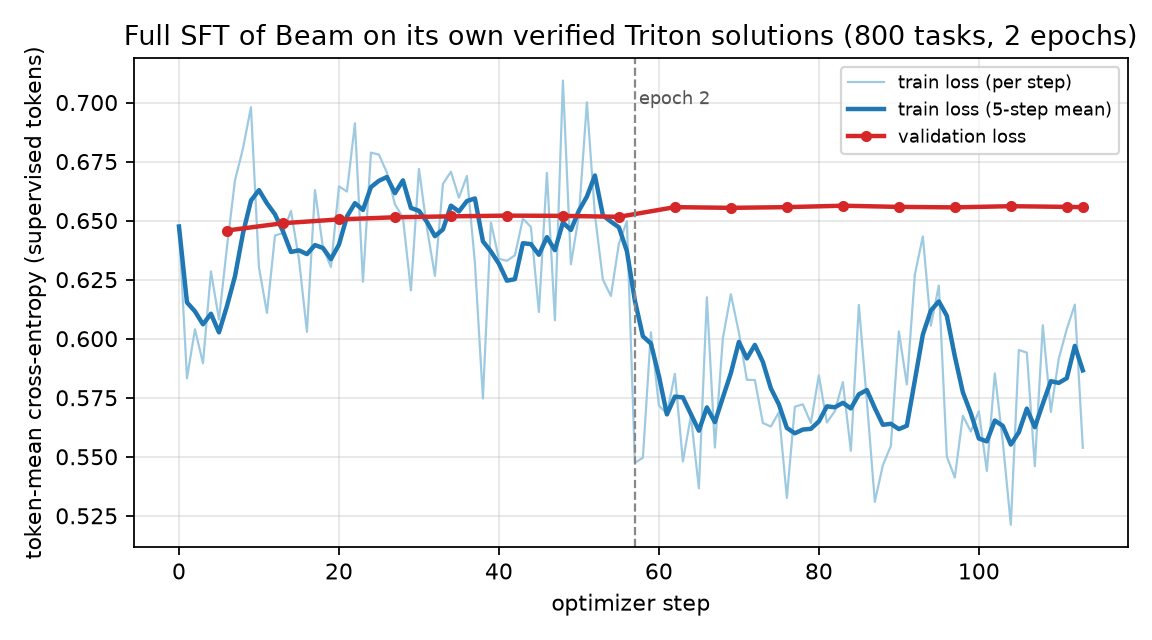
- A flat validation loss does not mean no learning. Training on the model’s own output leaves the loss signal slim; the verifier-measured pass rate is the metric that moves. See Results.
What you need
- Weights:
reflection/Beam-1.0-501B-A23B, about 1 TB. - Disk: about 5.6 TB free on the shared filesystem at the peak, at the end of the run: about 1 TB for the consolidated export plus about 4.6 TB of optimizer state saved next to it, which is not needed afterwards and can be deleted.
- Training environment: Python 3.12 with NeMo AutoModel, PyTorch with CUDA 13 and TransformerEngine, identical on every node. The install block is under Run it.
- The data scripts need
requests,huggingface_hub,pyarrowandtransformers; the verifier runs in its own venv with torch 2.14.0+cu130, triton 3.8.0 and numpy 2.5.3 (see DATA.md).
Run it
Set up the environment
Rebuild the task corpus
The manifest (dataset_manifest.json.gz) records, for each of the 1,000 tasks, where its reference module came from or how to regenerate it. The script fetches every referenced source at its pinned commit, applies the recorded transforms, regenerates the procedural tasks, re-renders the task texts and prompts, and checks each of them against the recorded hashes. It exits with code 1 if any task fails its check:
Sample and verify
Serve the base checkpoint with the same stack and flags used for the fine-tuned export below:max with up to 160k tokens, asks for up to sixteen attempts per task and stops at the first one the verifier accepts. Endpoint errors do not consume attempts: the same attempt is retried, and the run exits with code 1 if the endpoint keeps failing, so you can fix it and re-run with the same --out to resume:
--gpus and --verify-workers together to match them; a slot pointed at a GPU that does not exist records grader errors that consume attempts.
Security note. The verifier executes model-generated code. It restricts imports, disables sockets and caps memory and time, but it does not isolate the filesystem. Run the sampler on a dedicated machine or in a container that holds no credentials or data you care about.The verifier builds
Model and ModelNew from get_init_inputs(), copies the reference state into ModelNew, runs the reference on the CPU and the candidate on the GPU for several seeds and shapes with TRITON_F32_DEFAULT=ieee, compares with torch.testing.assert_close at the task’s tolerances, counts kernel launches and statically rejects torch computation inside ModelNew.forward. Samples with status PASS become training data. Sampling is stochastic: a run with these settings reproduces our data generation, not our exact samples.
Build the training rows
The first passing sample of each task becomes one example — the prompt, the model’s reasoning and its answer — rendered with Beam’s chat template at reasoning effortmax and tokenized with the loss on the assistant tokens. Rows longer than the packer’s 32,768-token budget are excluded and listed (--max-seq-tokens), so the training job never sees a row it would drop:
Train
The recipe is NeMo AutoModel’s Beam full-parameter recipe with the dataset and schedule replaced; it ships asrecipe_beam_triton_sft.yaml. Its four load-bearing choices:
- Precision: weights and compute in bf16, gradients reduced in fp32 (the FSDP2 default). The optimizer is TransformerEngine’s FusedAdam with fp32 master weights, stored as the bf16 value plus a 16-bit remainder, and fp32 Adam moments. At a learning rate of 1e-5 most per-step updates are smaller than bf16 resolution; without master weights they are silently rounded away. The price is 14 bytes of state per parameter, about 102 GiB per GPU at expert parallel 64 before any activations.
- Parallelism: expert parallel 64 (4 experts per GPU), FSDP2 for the dense parameters, context parallel 8 across each sequence, activation checkpointing, TransformerEngine attention; no tensor or pipeline parallelism.
- Data layout: packed sequences (THD) of 32,768 tokens, each document padded to a multiple of 2 x CP; 8 packs per optimizer step, about 262k tokens and 177k supervised tokens per step.
- Schedule: learning rate 1e-5 with 3 warm-up steps and cosine decay to 1e-6, betas (0.9, 0.95), no weight decay, gradient clipping at 1.0, seed 1234. Two epochs are 114 optimizer steps, validation loss every 7 steps, one checkpoint at the end with a consolidated HF safetensors export.
PYTHONPATH:
step N | epoch E | loss ... | mem ... | tps ...) and the validation loss every 7 steps; the final save writes epoch_1_step_113/model/consolidated/ with the HF safetensors (193 files) that load directly into an inference server.
<details>
<summary>The full training configuration</summary>
Evaluate before and after
The export is served unchanged, with the same tokenizer and chat template as the base model:max, temperature 1 and up to 120k tokens, four times per task, grades each sample with the same verifier, and reports pass@1 as the mean over tasks of the per-task pass rate, which keeps every task at equal weight. Base and fine-tuned model are served with the same build, flags and tokenizer, and the base checkpoint is identity-checked before the comparison.
Smoke test
Offline, no GPU, network or model files;--online also rebuilds three tasks from their pointers and checks the hashes:
Results


Common fixes
Next steps
- Iterate. Resample with the fine-tuned model, re-verify, retrain (expert iteration), and check whether the hard-task gains compound.
- Use the failed attempts. Preference pairs (fail vs pass on the same task) for DPO-style training.
- Agentic setting. Let the model test its own kernels on a GPU inside a sandbox before answering.
- Start smaller. The NeMo AutoModel Beam guide fine-tunes Beam with LoRA on one node of 8x H200 with the same stack.